
The fundamental things apply
"As Time Goes By"

As in all social interactions these days, one must start by acknowledging, to paraphrase the theme from the Lego Movie, everything is not awesome.
The day after the 2024 election in a family text chat our cousin Emily predicted and recommended that the key to getting through this period would be to act locally, even hyper-locally. It’s advice that I have taken and passed along to many others. Because there are places and institutions and ideas and people that many of us do have the power to protect amidst all the evil and chaos.
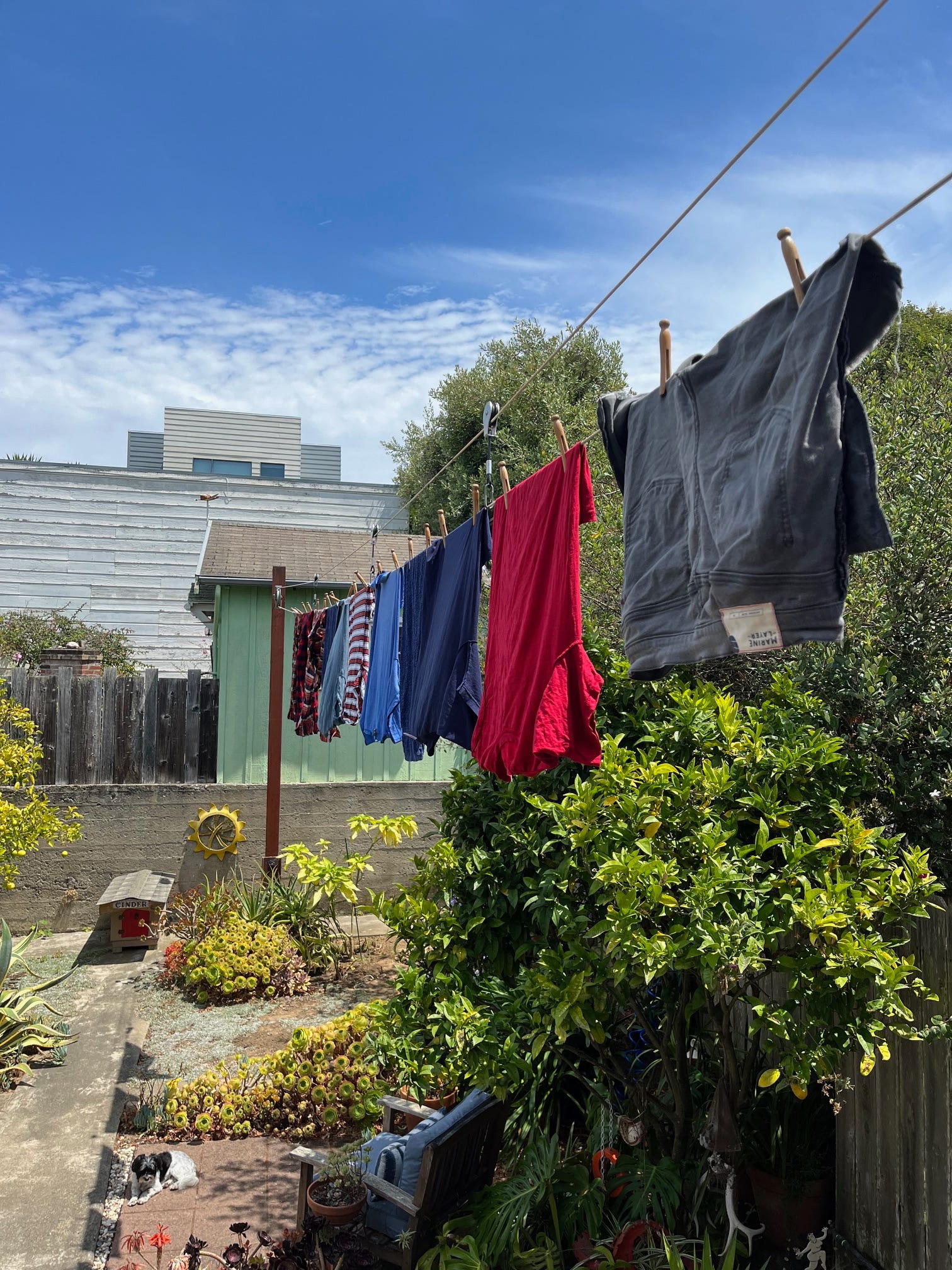
For me that’s shown up as a leadership role at church, over-tipping drag queens, buying books from independent stores, and drying clothes on a rack in our kitchen, or on sunny days on the clothesline in the backyard that my partner sourced from a company that mostly supplies Amish communities.
About the clothesline in the backyard, it’s kind of a pain, but very therapeutic. I literally think about Vladimir Putin every time I hang towels on the line and ponder the natural gas I’m not using as a result. It’s one of the few moments in my life when I feel like I have actual leverage over capitalism. The drying rack in the kitchen doesn’t give the same exact thrill—no direct contact with the sun or outside air—but as my brother and I learned from the Germans, it doubles as a no-cost humidifier.
“The fundamental things apply / as time goes by.” Good advice and a great song.
Balanchine at SF Ballet
As a lot of you already know, I spent most of the Obama administration writing a dissertation about the choreographer George Balanchine and his collaborative relationship with American impresario Lincoln Kirstein. The book version of it came out during the following administration when I was in a major career transition back to fundraising and right around when I was turning forty, a time of Big Transitions and Emotions.
I somewhat stumbled into this topic because of my interest in the decades when Balanchine came to the United States (the 1930-40s), before the U.S. had a mature nonprofit performing arts sector. I still want to write an article or book some day about the nonprofit arts institution as the last gasp of late late modernism (a critique, to be sure).
This means I’m now a lifetime member of the Balanchine thought community, which is mostly centered in New York, with San Francisco is a notable satellite chapter owing to the choreographer’s close ties with our ballet company.
And this is all prologue to plug that I’ll be leading a free panel discussion at the SF Ballet on Feb. 10 at 6pm with Artistic Director Tamara Rojo (the smartest person I have met in recent memory) and Elizabeth Kendall (a brilliant memoirist and historian and fellow Balanchine scholar). We’ll be talking prior to the opening night performance at the opera house of a triple bill of Balanchine ballets:
Diamonds (a 1967 homage to ballet classicism whose signature role was originated by the legendary Suzanne Farrell)
Serenade (the first ballet Balanchine created in America in 1933 and the subject of endless legend and lore - and a big part of my own research journey), and
Stars and Stripes (a 1958 Cold War Broadway-inspired patriotic romp set to John Philip Sousa marches, in a way that only Balanchine could pull off)
If you can’t be there on opening night try to see one of the other shows and in either case look for my program notes, which highlight Balanchine’s journey of immigration and becoming a US Citizen in 1939.
Tech Critiques Past and Present
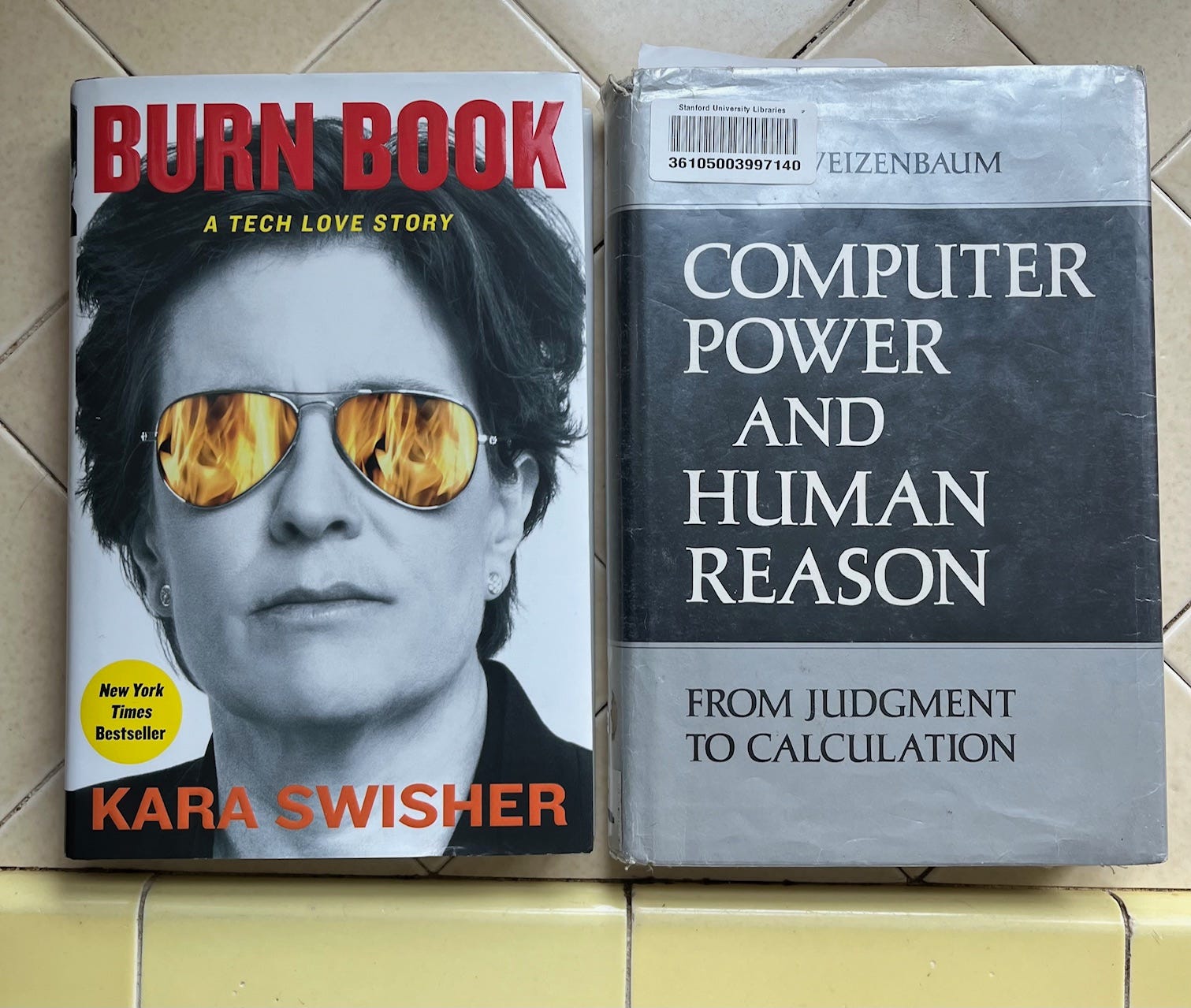
I have been doing more writing lately (yay) as part of a Stanford Continuing Ed class on memoir. But this has meant less reading (boo) and I’m currently in the middle of two books that could not be more different in terms of style and approach, but each offers a long view on what our phones and social media and yes, AI, is doing to us as people.
The more recent one is Kara Swisher’s Burn Book, a retrospective of her career covering Silicon Valley. Swisher is as close as the Bay Area gets to one of those “repent for the end is near” prophets and has been one of the few journalists to get up close with our billionaire tech titans and ask tough questions. Her book is a page turner and chock full of delicious anecdotes. Perhaps most important, it documents in real time how over the last two decades social media and tech companies starved traditional journalism of their revenue streams, and how traditional establishment media were in complete denial about the digital revolution. And now we have fewer reliable news outlets and endless unmoderated crap on Facebook.
It helps explain how we got to the point where part of our journalistic landscape is someone whose full time job is evidently writing and posting on Facebook literal fake news stories about the mascots of various sports teams dying (when they in fact have not died). Thank you to the folks at The Pickup for digging up this local story and teasing out its national implications.)
Soon after we relocated to the Bay Area we almost had dinner with Kara Swisher and her then girlfriend Nellie Bowles, who was then a reporter for the Guardian and is now married to Bari Weiss—crazy how the tides can shift. Dinner didn’t work out, sadly, and Kara only got more busy and famous after that.
The other book is the opposite of a page turner, an academic treatise from 1976 called Computer Power and Human Reason, by computer scientist Joseph Weizenbaum. A friend from church who is steeped in computer science and the tech world with a strong moral and ethical bent tipped me off about the enduring wisdom of this book, which is sadly out of print and not the easiest to track down. This book was written in part at Stanford, when Weizenbaum was a fellow at the Center for Advanced Studies in the Behavioral Sciences.
Weizenbaum was the creator of one of the first artificial intelligence interfaces, called ELIZA (the acronym an homage to Pygmalion/My Fair Lady), which could carry on reasonably engaging conversations with a human interlocutor, to the degree to which when one of his assistants was using it in his presence, she asked him to leave the room so he would not be eavesdropping on her private conversation.
His key question in the book, which I look forward to digesting in full: we know that computers can be taught to do anything, but does this mean that they should be taught and allowed to do everything? His answer over fifty years ago was no, when these technologies were in their infancy. Now that they are more powerful than ever, it’s insane that we are all being pressured to just say yes yes yes.
Yes to: Fast Buses, Progressive Christianity, Kennedy Center Drag Parody
Yes to making the buses fast and free. Mayor Mamdani has a chance at making the buses free and fast in part thanks to New York City’s congestion pricing, which is proving to be a success by almost every measure, and is even winning over drivers who opposed it. This visual article from NYT explains it all.
In the winter I take the 48 bus from our house to Caltrain, and can confirm from daily personal experience that one of the biggest barriers to faster transit is too many cars. I pray that Bay Area and California politicians and policymakers can muster the courage to bring congestion pricing here. But man is that gonna be a fight cause Californians really love their cars.
Yes to reclaiming Christianity. Texas Senate candidate James Talarico is getting a lot of attention for his reframing and reclaiming Christianity for progressive ends. I am curious how much the message will break through. It certainly resonated with me as someone who has stuck with Christianity and church in part because I think it’s too important of a cultural resource to cede entirely to right wingers.
You can find Talarico everywhere these days but I listened an interview by Ezra Klein. Like most podcasts I found it a half hour too long but I was pretty much saying Amen the whole time.
Yes to the Kennedy Davenport Center Honors. RuPaul’s Drag Race fans will remember that a few years ago the “All Stars All Winners” season had the queens roast each other in an awards show called the Kennedy Davenport Center Honors Hall of Shade.
Happily, the wonderful people at World of Wonder saw fit to develop this bit into a full half hour standalone faux awards show, the Kennedy Davenport Center Honors, hosted by Kennedy herself. Kennedy is a Texas queen who seems to speak entirely in catchphrases, which were repurposed into categories including the “Eyeroll Award,” “Opinions Are Like Buttholes Award,” and “The Struggle Is Real Award.”
The show promised to and indeed did recognize “the best, the brightest, the delusional,” and since I will not be watching the actual Kennedy Center Honors any time soon this show was a blessing. (I can’t say I recommend it to anyone who is not already steeped in the RuPaul Drag Race multiverse as the many inside jokes will be lost on the uninitiated.)
In the course of the show Kennedy coined yet another catchphrase that is going to be my anti-AI watch-cry: “I don’t trust robots, I don’t even know, girl.” (I do trust Waymo, for the record.) Maybe Kara Swisher can get that award next year.

Strong street pole game in our neighborhood of late. Resist and Join Your Union!
Thanks for reading, and please subscribe or forward to a friend who might also enjoy this monthly miscellany.
I loved the interview with Talarico too! And as someone whose is very averse to organized religion, I was really intrigued by his perspectives.
And I will now think of you when hanging
my laundry 😂
Love these posts, Jim. Keep the coming!