
Magnificent Humanity
Pope Leo on AI, along with Ronan Farrow, Lena Dunham, and Heated Rivalry

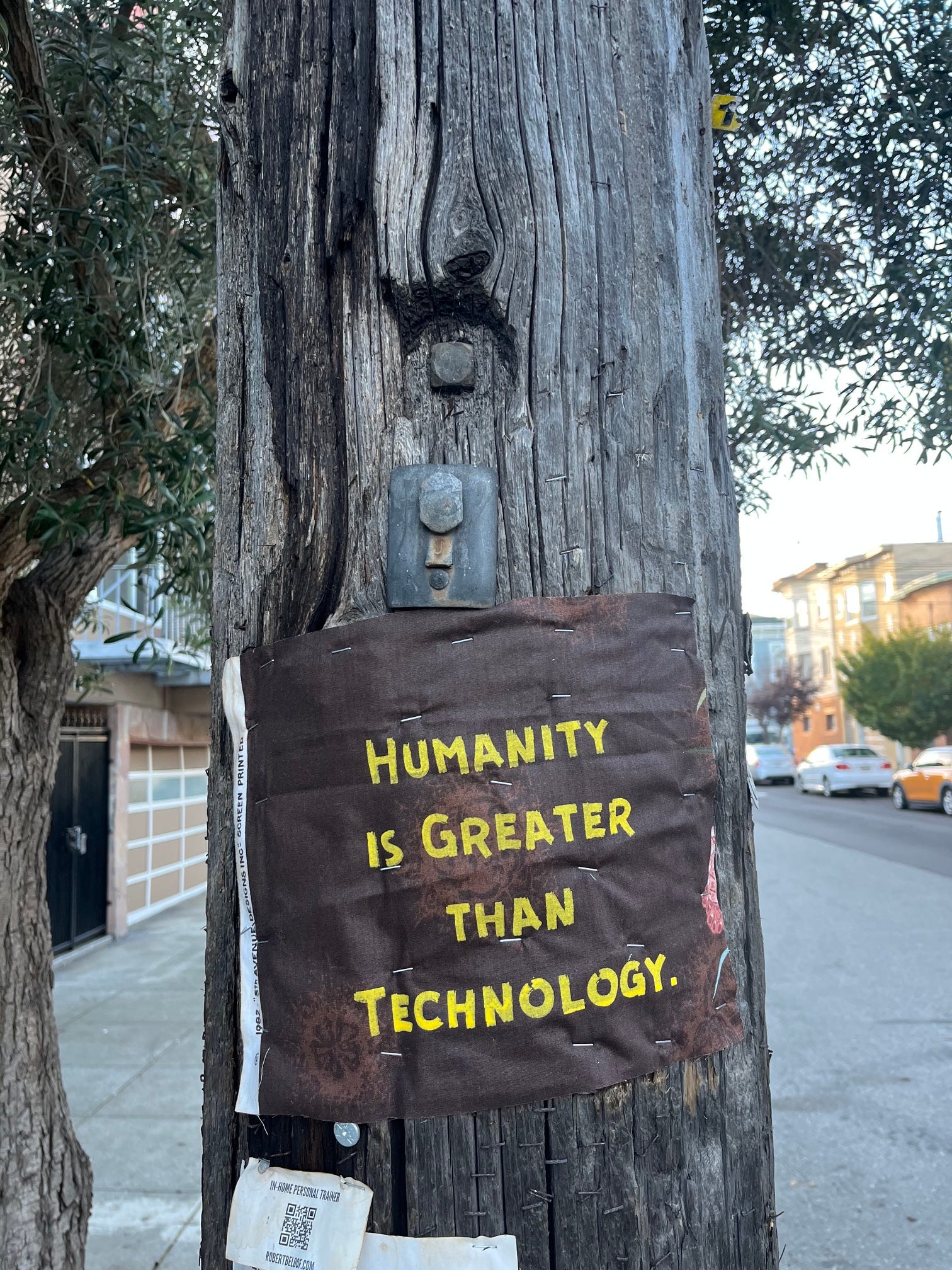
I first noticed this sign in our neighborhood in November 2025. It’s not lost on me that I know when I first saw it thanks to the date stamp recorded by my iPhone. In another ironic twist, this sign that has become a source of solace is located at the intersection of Jersey and Church where Waymo always picks us up and drops us off.
I’m grateful to the anonymous public artist who has helped me articulate the knee jerk skepticism I increasingly feel towards tech and especially AI. My resolve has been stiffened reading coverage such as Ronan Farrow’s New Yorker profile of Sam Altman. Among the details that disturbed me most was learning that Altman met his husband in a hot tub at a party hosted by Peter Thiel. I have no problem with meeting your future husband in a hot tub. But at the home of Peter Thiel? As the Sassy Gay Friend famously advised a confused Juliet about to kill herself over a boy she just met a few days earlier: “Look at your life, look at your choices.” My stance on AI is so established that my partner didn’t even ask before buying me this t-shirt.

Around the same time he also bought me a hat with the Advil logo, which sparks an equal amount of conversation from strangers. I have considered pairing them, but that would be too on the nose.
*****
In the months since the “humanity” sign went up near our house, I have begun to try on a different label to name my feelings about AI, choosing the moniker “conscientious objector,” which was deployed by men during the Vietnam era seeking to opt out of military service due to religious and moral reservations. This began as something of a joke, but after two or three times using it I realized it captured the depth of my reservations.
And thus it should probably not have surprised me that in yet another ironic turn the person who has best been able to articulate the underlying unease I feel about tech and AI is Pope Leo XIV, the head of the Roman Catholic Church in which I was raised but formally left over a decade ago. “Magnificent Humanity” is the English title of the recently released encyclical by the Pope, outlining a theological and moral case for a measured approach to these and other powerful technologies.
If you don’t have previous familiarity with the Catholic tradition and theology, the Pope’s ca-200 page essay might be tough going, although it’s worth a try and widely available online and in various printed formats. My brother and I had been texting about it since its release and I shared that I wanted to wait until I could read it in print, not wanting to consume it in a distracted manner. He surprised me with a printed copy that arrived over Pride weekend.
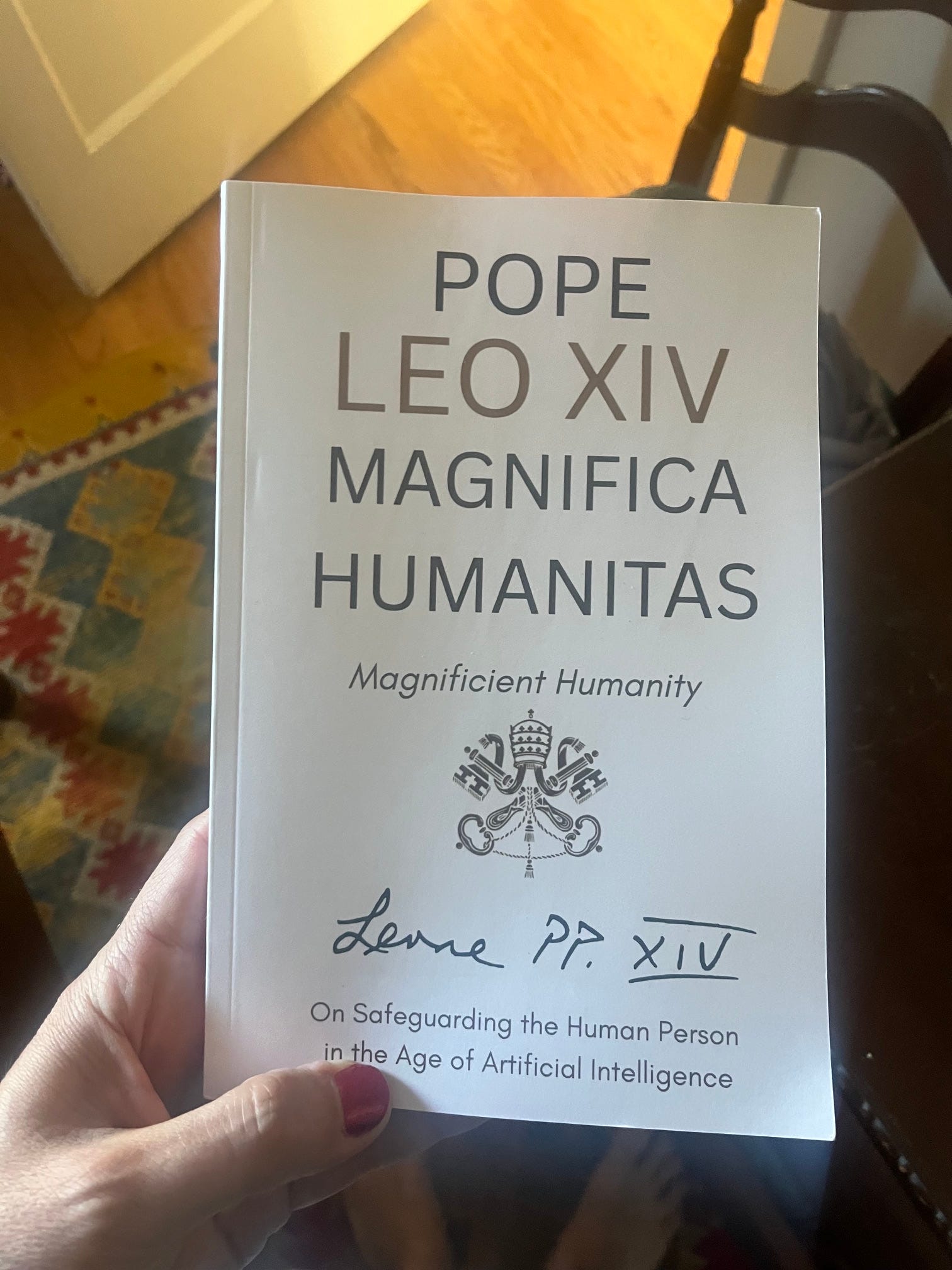
I do not always read with a pen or pencil in hand these days, but ran for one as soon as I started reading “Magnificent Humanity.” And even though I’m only halfway through, I have already found a dozen sentences that I might feel compelled to print out and staple to a telephone pole:
“The value of persons does not depend on what they achieve or produce.”
“It is an illusion to think that simply pursuing one’s own progress without caring for others is sufficient for contributing to the good of all.”
“Calling for prudence, rigorous evaluation and even, at times, a slower pace in adopting AI does not mean opposing progress; instead, it is an exercise of responsible care for the human family.”
*****
Among the most quoted sections of the encyclical has been a passage that speaks directly to the stakes of AI adoption, in particular generative AI that can appear to act and behave in a manner that imitates humans. And he has the receipts on the inherent limitations of this “intelligence”:
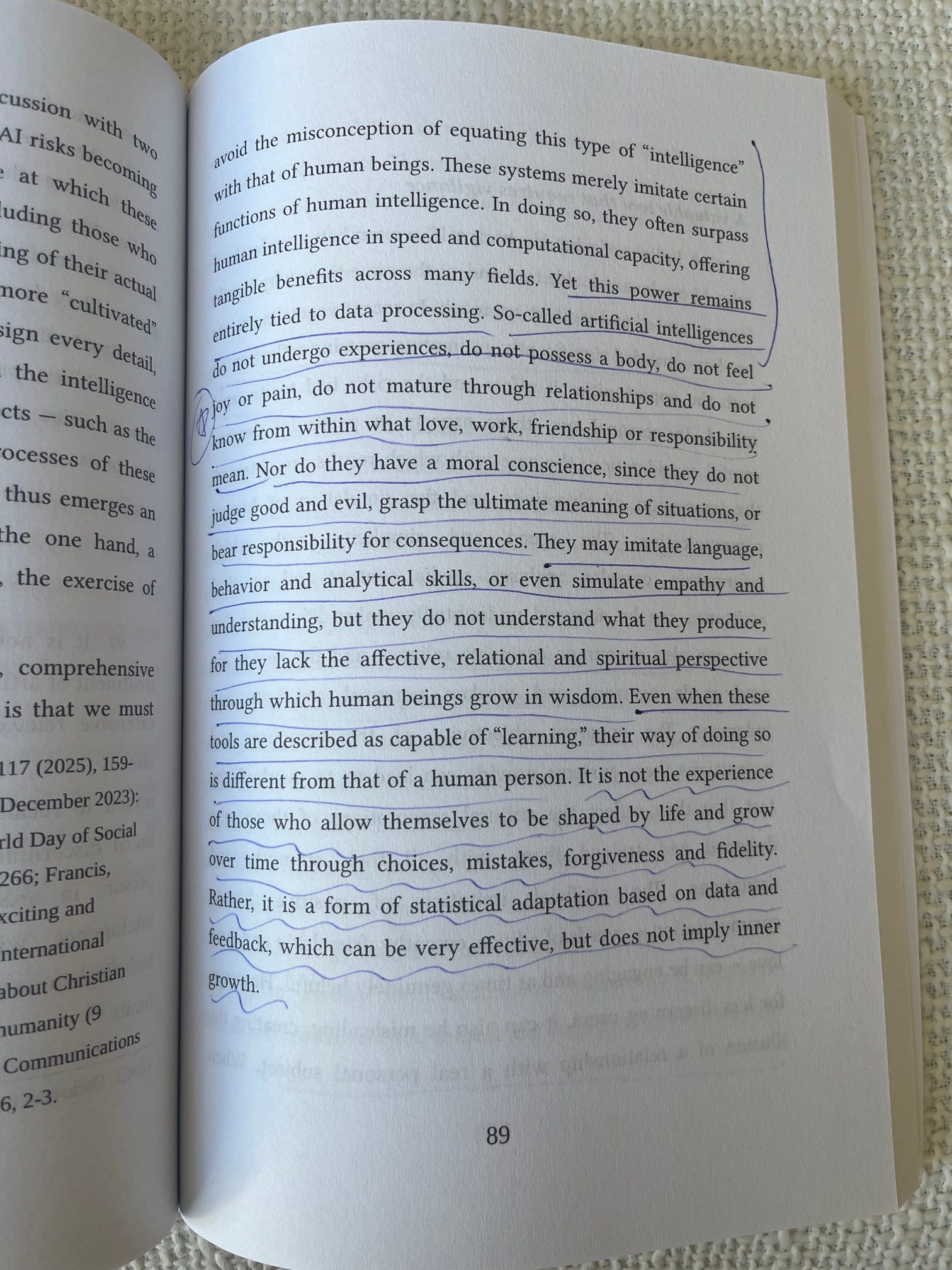
“So-called artificial intelligences do not undergo experiences, do not possess a body, do not feel joy or pain, do not mature through relationships and do not know from within what love, work, friendship or responsibility mean. Nor do they have a moral conscience, since they do not judge good and evil, grasp the ultimate meaning of situations, or bear responsibility for consequences. They may imitate language, behavior and analytical skills, or even simulate empathy and understanding, but they do not understand what they produce, for they lack the affective, relational and spiritual perspective through which human beings grow in wisdom.”
I’m tempted to just keep transcribing, but then I’d just be reproducing the rest of the section - below is the whole page in question if you’re curious. As you can see I couldn’t help myself with my underlining, resorting to a squiggly variation to note my growing enthusiasm as this paragraph reached its conclusion.
******
The concept of being “shaped by life” noted above has been ever present over the last month, as people in our family have been navigating unexpected physical and emotional traumas. Without going into too much detail about stories that are not mine to tell, I’ll just say that I have a renewed appreciation for the connections between our minds and bodies. Anyone who has been around me recently will tell you that I am endlessly quoting the advice from a fellow writer rearticulated by Laura Goode in her book, in which she cautions that your body is not merely a plant stand for your mind: “If you wish to outlive your sources, rivals, and enemies, then treat your body as you would a beloved friend.”
And while you’re at it, you also get to choose how to treat your mind, which is a way of taking care of your body. Since leaving the academic life I’ve embraced Goodreads as a way to log and track my reading, and take pleasure in the juxtaposition of titles I am sometimes reading at the same time. As I work to get back on track towards my 40 book goal for the year, the collective presence of these three titles brings me a lot of joy and is a reminder of what humanity is all about:

Ten years ago I would have not have been caught dead reading a book like Lena Dunham’s memoir and certainly would not want it to be known that I was “wasting” my time on something as trivial as one of the Heated Rivalry romance novels. Or if I did deign to read them I certainly wouldn’t post about it publicly. Reading was serious business in academia, and one had to cultivate a careful persona of rigor.
But Dunham’s life of creative and bodily chaos and an absolutely unsubtle gay romance written by a straight woman have been for me the perfect companions to Pope Leo’s moral and theological musings. I am reminded that even though a computer can read infinitely faster than me, it will never set a reading goal that it struggles to meet, much less worry about or resolve to get back on track. It can never read for any truly human purpose—curiosity, pleasure, escapism, witnessing, prurience—and by definition does not get to make unexpected choices such as this. And it certainly cannot pause to reflect on what it might mean.
Meditations on Tulsa and Urbanism
In closing, another reason this July post is a day late is that I’ve been up to some other writing, including an essay on “Loving Tulsa for the City it Is” published around the Fourth of July. Interestingly this piece came about thanks to a “prompt”—someone told me that term is an AI thing?—from the editors of The Pickup, which was assembling a collection of articles on the concept of urbanism.
Thankfully they did not object when I decided to take the piece in a more personal direction, offering reflections on several human relationships. The Pickup has a partially porous paywall, so I hope you’ll click through and read it here.